
Why More Training Is Rarely Better — And Often the Reason People Stall
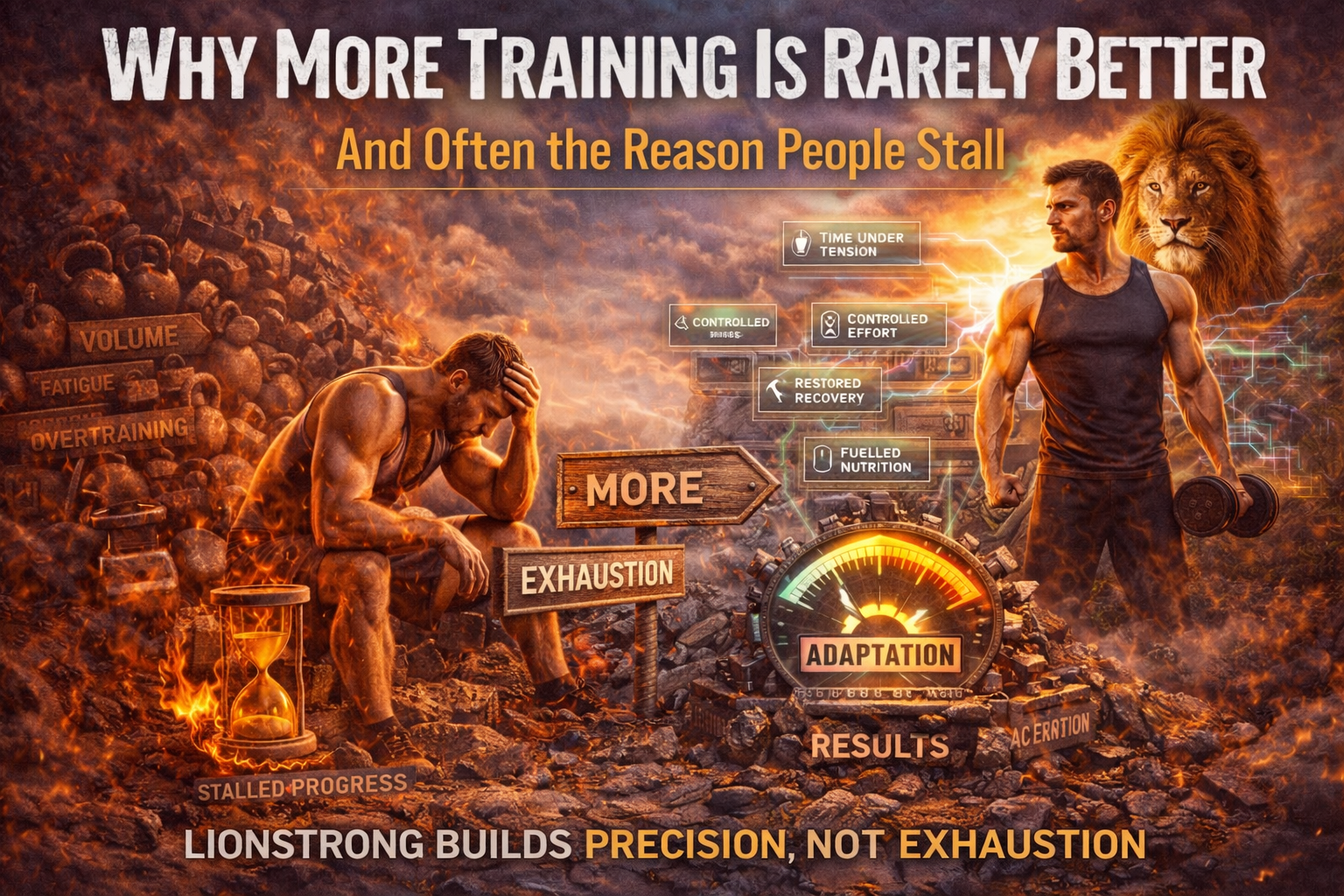
The “More Is Better” Trap
If there is one belief that silently destroys progress, it’s this:
“If I’m not doing enough, I need to do more.”
More workouts.
More volume.
More exercises.
More days.
More fatigue.
This belief feels logical. It feels disciplined. It feels committed.
But physiologically, it is one of the fastest ways to stall results, slow recovery, and break the body down over time.
Progress does not come from how much you do.
It comes from how well the body can adapt to what you do.
And adaptation has limits.
The Body Does Not Reward Excess — It Punishes It
The human body is not impressed by effort for effort’s sake.
It adapts only when:
stress is meaningful
recovery is sufficient
signals are clear
demand is repeatable
When training volume exceeds recovery capacity, the body responds defensively.
Instead of adapting, it begins to:
downregulate energy output
suppress muscle growth
increase inflammation
heighten injury risk
This is why many highly active people look worn down rather than athletic.
They are training past adaptation, not into it.
Why Volume Became the Default (And Why It’s Misleading)
High-volume training became popular because:
it looks productive
it fills time
it feels exhaustive
it’s easy to market
Fatigue is visible.
Soreness is tangible.
Exhaustion feels earned.
But fatigue is not progress.
Fatigue is simply the cost of training — not the result.
Lionstrong does not chase fatigue.
It chases stimulus efficiency.
The Difference Between Stimulus and Noise
Not all stress is equal.
Stimulus is:
targeted
intentional
repeatable
recoverable
Noise is:
excessive
random
redundant
unrecoverable
Most people add volume when they should refine stimulus.
They do more exercises instead of:
increasing tension
improving control
extending time under load
training closer to failure
Lionstrong systems reduce noise and amplify signal.
Why Recovery Is the Limiting Factor (Not Motivation)
Most people believe their limiting factor is motivation.
In reality, it is recovery capacity.
Recovery is governed by:
sleep
nutrition
nervous system stress
connective tissue tolerance
When recovery is exceeded:
progress stalls
strength regresses
joints ache
motivation declines
This is not a character flaw.
It is a biological boundary.
Smart training respects boundaries while still forcing adaptation.
Why Shorter Sessions Produce Better Long-Term Results
Long sessions feel impressive.
But they require:
perfect scheduling
high mental bandwidth
extended recovery windows
lifestyle sacrifices
Short, dense sessions:
fit real life
reduce friction
allow higher consistency
preserve recovery
Lionstrong prioritizes:
under-30-minute sessions
time-based effort
minimal setup
maximum return per minute
This is not minimalism for convenience.
It is precision for longevity.
Why Muscle Growth Requires Restraint
Muscle grows when:
it is stressed sufficiently
it is allowed to recover
it receives nutrients
the signal is repeated
Excess volume interferes with all four.
Too much training:
blunts protein synthesis
elevates cortisol
delays tissue repair
degrades signal clarity
More work does not equal more growth.
Better work does.
The Nervous System Cost of “Always More”
Training is not only muscular.
It is neurological.
Every session taxes:
motor coordination
neural drive
cognitive focus
When volume is excessive:
coordination declines
movement quality suffers
injury risk increases
fatigue becomes systemic
Lionstrong systems manage neural fatigue, not just muscle fatigue.
That’s why movement quality improves over time instead of degrading.
Why Elite Results Look Simple (Because They Are)
High-level outcomes often look boring from the outside.
The exercises repeat.
The structure stays consistent.
The progression is subtle.
This is not accidental.
Elite results come from:
repeating the right stimulus
allowing adaptation to compound
resisting the urge to add chaos
Lionstrong embraces repetition with intent.
Novelty is not the goal.
Progress is.
The Psychology of Doing Less, Better
Doing less requires confidence.
It means trusting:
the process
the signal
the system
Many people overtrain because they don’t trust that what they’re doing is enough.
Lionstrong removes that doubt by:
standardizing effort
controlling duration
anchoring nutrition
managing recovery
When effort is honest and structure is sound, less is enough.
Why Longevity Demands Precision
Bodies don’t break down from training.
They break down from mismanaged training.
Excess volume accelerates:
joint wear
connective tissue strain
hormonal disruption
nervous system burnout
Precision preserves:
strength
movement quality
recovery capacity
lifespan of training
Lionstrong trains people not just for now — but for decades.
Final Thought: Adaptation Rewards Intelligence, Not Excess
The body does not reward chaos.
It rewards clarity.
It rewards consistency.
It rewards signals it cannot ignore — followed by recovery it can trust.
More is rarely better.
Better is better.
And better is built through systems — not exhaustion.
That is the Lionstrong approach.