
Why Your Body Stops Responding When Training Becomes Too Predictable
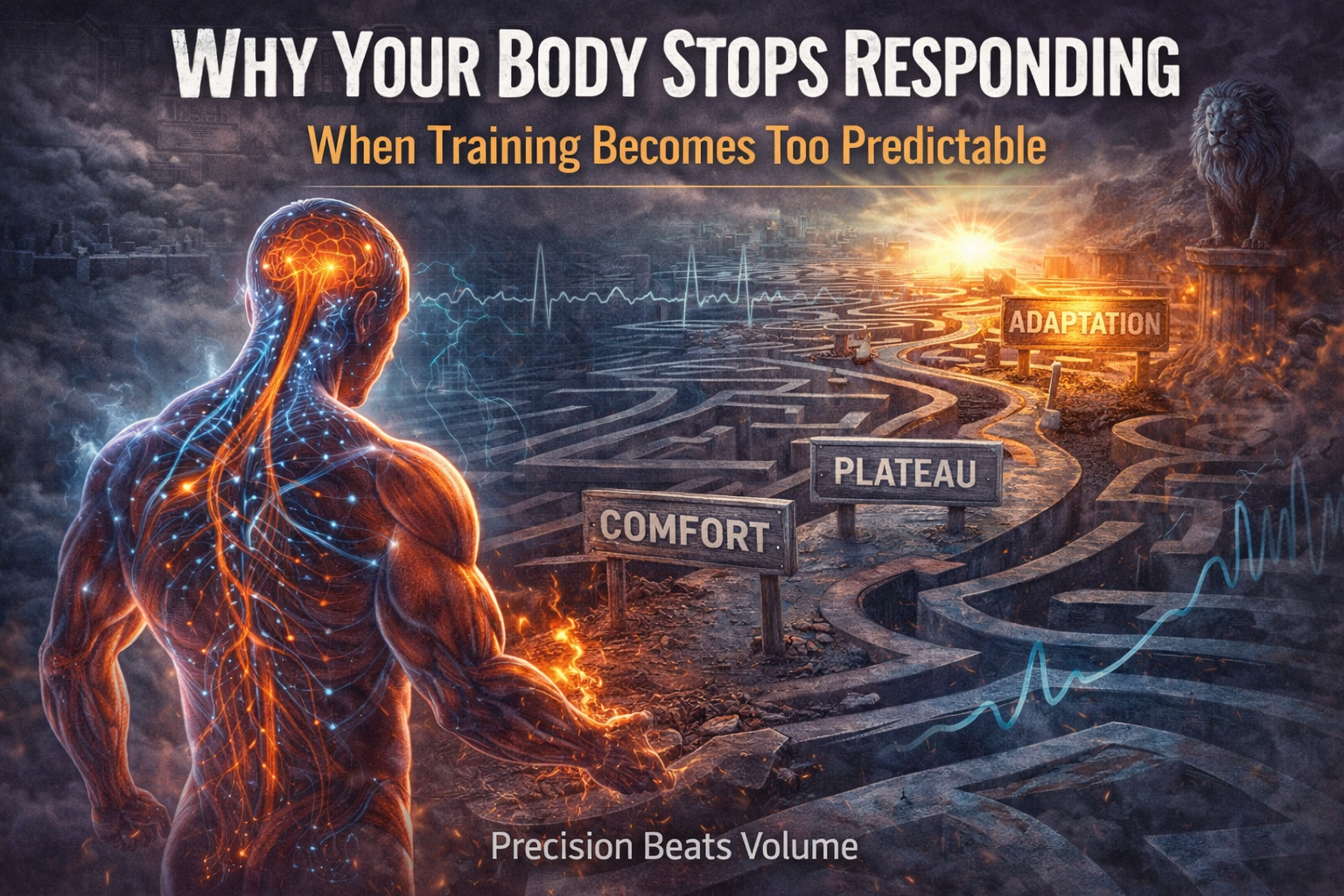
When “Consistency” Quietly Becomes the Problem
Consistency is praised as the holy grail of fitness.
Train consistently.
Eat consistently.
Stick to the plan.
And yet, many people do exactly that — and still stall.
They:
show up
follow the program
hit the workouts
eat “well enough”
But their body stops responding.
This is where confusion sets in.
The problem isn’t laziness.
It isn’t lack of effort.
It isn’t even lack of discipline.
It’s predictability.
The Body Is Brilliant at Pattern Recognition
The human body is not reactive — it is anticipatory.
It learns patterns quickly.
When the body can accurately predict:
how much stress is coming
how long it will last
how often it occurs
how well it will recover
…it adapts away from change.
This is efficiency.
Once the body concludes:
“I can survive this as-is,”
there is no reason to invest energy into further adaptation.
Plateaus are not failures.
They are signals of mastery over the current demand.
Why “Doing the Same Program Longer” Often Backfires
Many people are told:
“Just stick with it longer.”
Sometimes that works.
But often, it doesn’t — because time alone does not increase demand.
If:
tension is capped
effort is predictable
fatigue is manageable
recovery is guaranteed
the body simply maintains.
Maintenance feels like effort — but it produces no change.
This is why people can train for years and look the same.
The Difference Between Structure and Predictability
This distinction is critical.
Structure is necessary.
Predictability is limiting.
Structure provides:
clarity
repeatability
consistency
Predictability removes:
urgency
threat
necessity
Elite systems preserve structure while subtly disrupting predictability.
That is where Lionstrong separates itself.
Why the Body Only Changes Under “Unavoidable Demand”
The body changes when:
effort cannot be escaped
fatigue accumulates honestly
recovery is earned, not guaranteed
output is demanded under constraint
This does not require randomness.
It requires strategic variability inside a fixed structure.
Lionstrong achieves this through:
time-based sets instead of rep targets
constant tension instead of reset points
proximity to failure instead of comfort
controlled ranges that eliminate momentum
The structure stays familiar —
the demand does not.
Why Rep-Based Training Becomes Predictable Too Quickly
Rep-based training teaches the body exactly when relief is coming.
“Just two more reps.”
“Almost done.”
“Next set is easier.”
This allows:
subconscious pacing
energy conservation
partial engagement
Time-based effort removes that certainty.
The body cannot negotiate with the clock.
This restores urgency — even within the same exercises.
Why Comfort Kills Adaptation Faster Than Intensity
The body does not need intensity to adapt.
It needs uncertainty about its capacity.
When training becomes comfortable:
joints feel safe
muscles feel capable
nervous system relaxes
This is not a bad thing — unless the goal is change.
Lionstrong keeps discomfort productive, not chaotic.
Enough to demand adaptation.
Not enough to cause breakdown.
The Nervous System’s Role in Plateaus
Plateaus are often neurological, not muscular.
The nervous system:
learns movement patterns
optimizes energy output
reduces unnecessary recruitment
When training becomes predictable:
fewer motor units are recruited
force production plateaus
muscular demand drops
Time under tension and constant tension force the nervous system to:
stay engaged
recruit deeper fibers
coordinate under fatigue
This reignites adaptation.
Why Variety Alone Is Not the Answer
Many people respond to plateaus by adding variety.
New exercises.
New splits.
New programs.
But variety without structure is chaos.
The body never receives a consistent signal long enough to adapt deeply.
Lionstrong does the opposite:
keeps exercises familiar
changes how they are experienced
increases demand without novelty addiction
The signal deepens instead of resets.
Why Lionstrong Progress Feels Subtle — Then Obvious
Early progress in Lionstrong often feels:
quiet
controlled
uneventful
Then suddenly:
strength jumps
endurance increases
physique changes
joints feel better
This is because the system removes predictability before the body realizes what’s happening.
Adaptation happens underneath awareness.
That’s the most durable kind.
Long-Term Adaptation Requires Intelligent Disruption
Bodies that stay responsive long-term are trained with:
stable structure
variable demand
honest effort
recoverable stress
This is how elite performers train — whether they realize it or not.
Lionstrong simply applies this logic intentionally.
Final Thought: Predictability Is the Enemy of Progress
Consistency matters.
Structure matters.
But predictability ends progress.
The goal is not to surprise the body —
it’s to remove its ability to relax into certainty.
Lionstrong systems do exactly that.
Quietly.
Intelligently.
Relentlessly.
That’s why progress resumes — and keeps going.