
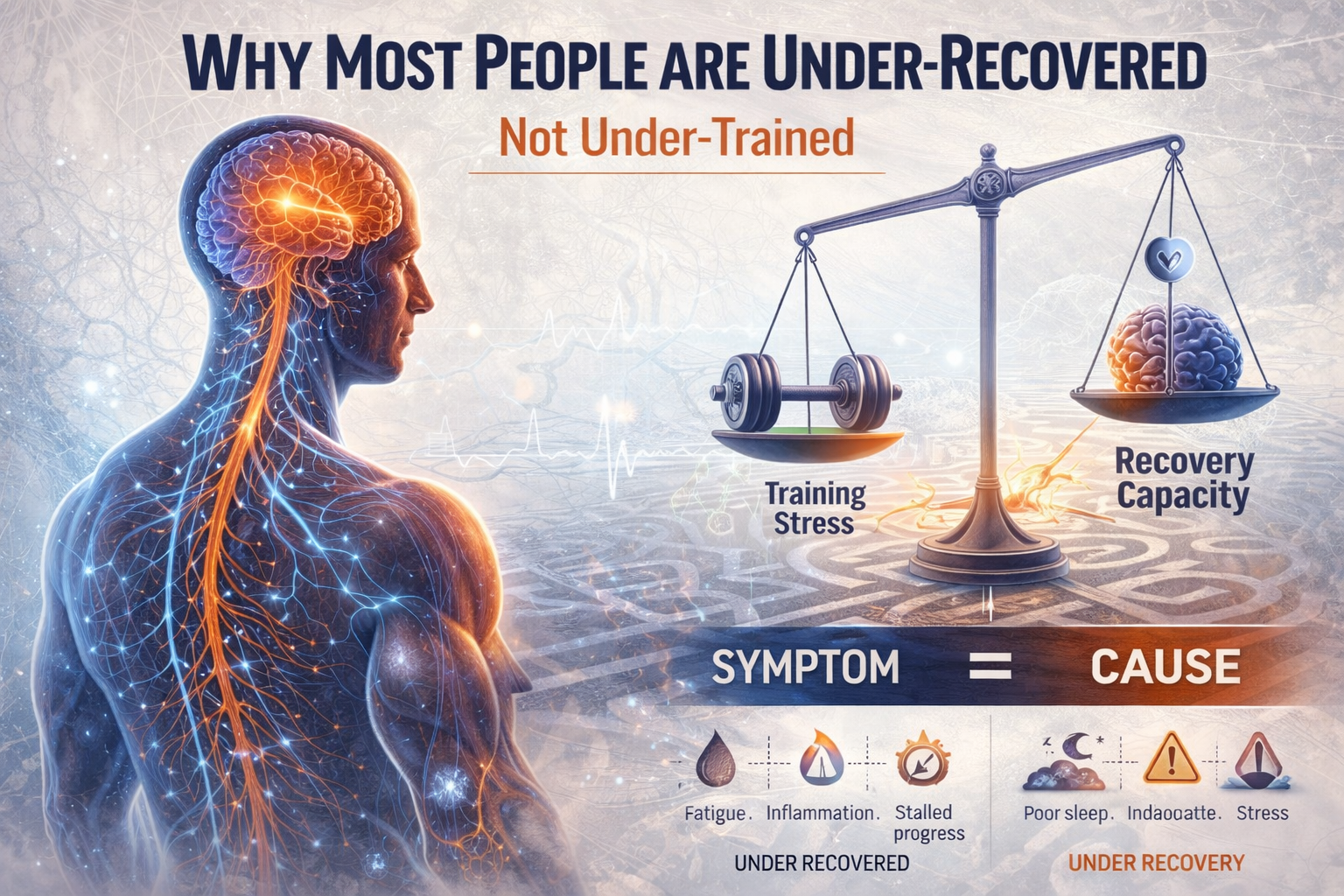
Why Most People Are Under-Recovered — Not Under-Trained
The Misdiagnosis That Keeps People Stuck
When progress stalls, the default assumption is almost always the same:
“I need to train harder.”
“I need to do more.”
“I’m not pushing enough.”
This assumption is so deeply embedded in fitness culture that few people ever question it.
But in reality, a massive percentage of people are not failing because they lack effort —
they are failing because their body cannot recover from the effort they’re already applying.
The problem isn’t training intensity.
It’s recovery capacity.
The Body Has a Finite Adaptation Budget
The body adapts using limited resources.
These resources include:
nervous system bandwidth
hormonal balance
connective tissue repair
immune function
sleep quality
Every stressor draws from the same pool.
Training is one stressor.
Work stress is another.
Poor sleep is another.
Emotional stress is another.
Undereating is another.
The body doesn’t distinguish between them.
It simply asks:
“Do I have enough capacity to adapt right now?”
When the answer is no, progress halts — regardless of how “good” the training looks on paper.
Why Training Culture Ignores Recovery Intelligence
Recovery is not glamorous.
It doesn’t:
feel heroic
create soreness
generate adrenaline
produce dramatic stories
So it’s often dismissed or oversimplified.
Most advice stops at:
“sleep more”
“stretch”
“take a rest day”
But recovery is not passive.
It is an active physiological process that determines whether training stress becomes adaptation — or damage.
The Nervous System: The Silent Limiter
Most people think fatigue is muscular.
In reality, it is often neurological.
The nervous system governs:
motor unit recruitment
coordination
force production
recovery signaling
When the nervous system is overtaxed:
strength drops
motivation fades
joints feel achy
sleep quality declines
And yet, people respond by adding more training.
This compounds the problem.
Lionstrong systems are built with the nervous system in mind — not just muscles.
Why Constant Fatigue Is a Red Flag — Not a Badge of Honor
Feeling constantly tired is often normalized.
People assume:
soreness is progress
exhaustion means effectiveness
pain is the price of results
But chronic fatigue is a sign that:
recovery signals are being ignored
stress exceeds capacity
adaptation is being suppressed
The body cannot build while it is constantly defending.
Lionstrong prioritizes recoverable intensity, not maximal exhaustion.
Why Short, Structured Training Supports Recovery Better
Long, draining workouts tax:
the nervous system
hormonal balance
connective tissue
sleep quality
Short, structured sessions:
limit systemic fatigue
preserve recovery bandwidth
allow higher weekly consistency
reduce cumulative stress
This is why Lionstrong training stays under 30 minutes by design.
Not because longer sessions don’t work —
but because they cost too much to sustain long-term.
Recovery Is Not Rest — It’s Regulation
Recovery is not simply the absence of training.
It is the body returning to a state where:
the nervous system is regulated
inflammation is controlled
tissue repair can occur
hormonal signaling normalizes
This is influenced by:
sleep quality (not just duration)
breathing patterns
nutrition reliability
psychological stress
Lionstrong nutrition systems support recovery by:
stabilizing blood sugar
providing adequate protein
reducing inflammatory volatility
supporting hormonal balance
Training and recovery must cooperate — not compete.
Why Under-Recovery Mimics Overtraining
Under-recovery creates symptoms people mistake for poor training:
stalled fat loss
declining strength
joint discomfort
low motivation
inconsistent energy
So they add:
more volume
more intensity
more cardio
Which pushes recovery even further behind.
This loop keeps people stuck for years.
The solution is not doing more.
It’s doing what the body can actually adapt to.
Capacity Comes Before Performance
Performance is an output.
Capacity is the foundation.
Capacity includes:
how well you sleep
how well you recover
how well you regulate stress
how consistently you fuel
Without capacity:
intensity backfires
progress becomes fragile
injuries accumulate
Lionstrong builds capacity first —
so performance can rise without collapse.
Why Longevity Depends on Recovery Mastery
The body does not break down from training.
It breaks down from unrecovered training.
Over decades, poor recovery leads to:
joint degeneration
chronic inflammation
hormonal disruption
metabolic inflexibility
Smart recovery preserves:
movement quality
strength retention
nervous system health
long-term resilience
This is why elite performance and longevity share the same foundation.
Final Thought: Progress Requires Capacity to Absorb Stress
Training provides the stimulus.
Recovery determines the outcome.
If the body cannot absorb stress, it will resist change —
no matter how intelligent the program looks.
Lionstrong systems are built to:
respect recovery
regulate stress
preserve capacity
force adaptation without breakdown
That’s how progress becomes sustainable — and permanent.