
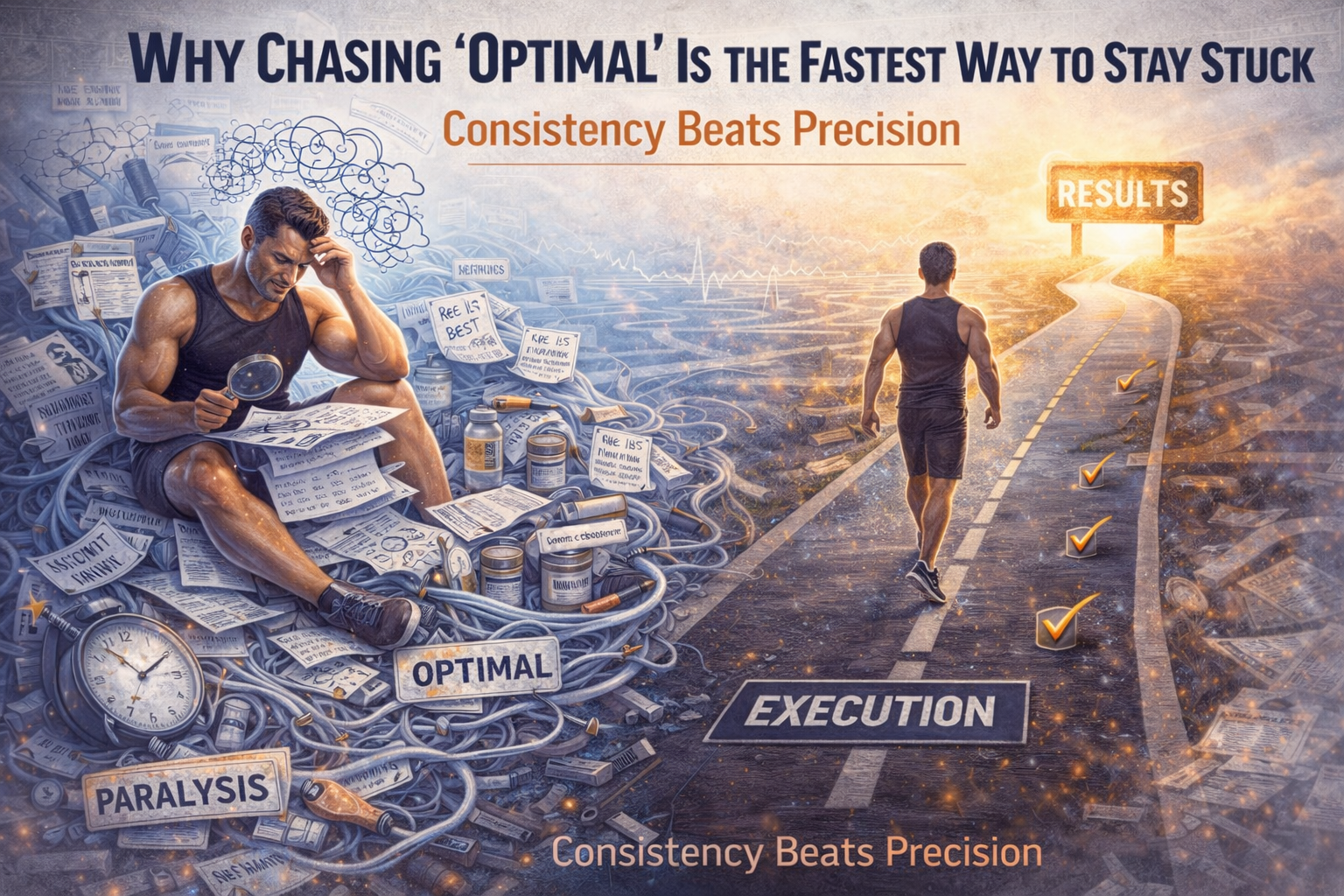
Why Chasing “Optimal” Is the Fastest Way to Stay Stuck
The Seduction of Optimization
Modern fitness culture is obsessed with optimization.
The perfect split.
The perfect exercise selection.
The perfect macro ratio.
The perfect supplement stack.
The perfect recovery protocol.
On the surface, this looks intelligent.
In reality, it’s one of the most destructive forces in long-term progress.
Because when people chase “optimal,” they rarely execute anything consistently.
They delay.
They hesitate.
They overthink.
They restart endlessly.
And the body never adapts to intentions — only to execution.
Why “Optimal” Sounds Smart but Fails in Practice
Optimization assumes a stable environment.
It assumes:
perfect sleep
predictable schedules
low stress
ideal recovery
unlimited time
Real life provides none of that.
When conditions change — and they always do — optimized plans collapse.
What replaces them is:
frustration
decision paralysis
constant program hopping
self-doubt
The pursuit of optimal becomes the excuse for never committing fully to anything.
The Body Does Not Reward Precision — It Rewards Repetition
Physiologically, the body adapts to repeatable signals, not perfect ones.
Muscle grows because:
tension is applied repeatedly
effort is close enough to failure
recovery is sufficient
the signal recurs
The body does not ask:
“Was this the best possible workout?”
It asks:
“Is this demand happening again?”
Consistency beats precision every time.
Why Optimization Creates Mental Fatigue Before Physical Fatigue
Chasing optimal requires constant decisions:
Should I train today or rest?
Is this the best exercise?
Should I change my split?
Should I adjust calories?
Am I doing enough?
Every question drains cognitive bandwidth.
Decision fatigue leads to:
skipped sessions
inconsistent nutrition
emotional training choices
burnout
Lionstrong systems remove unnecessary decisions so energy can be spent on execution, not deliberation.
The Hidden Cost of Waiting for the “Best” Plan
Waiting feels responsible.
But physiologically, waiting is neutral.
Neutral does not produce adaptation.
Every week spent optimizing instead of executing:
delays progress
weakens confidence
reinforces indecision
The body does not reward preparation.
It rewards exposure to stress over time.
Why “Good Enough” Systems Produce Elite Results
Elite performers rarely chase perfect.
They chase:
reliable structure
predictable effort
manageable recovery
long-term sustainability
They repeat “good enough” exceptionally well.
Lionstrong systems are intentionally designed to be:
simple to execute
difficult to escape
repeatable under stress
adaptable without overthinking
This is how progress compounds quietly — then dramatically.
The Difference Between Optimization and Intelligence
Optimization asks:
“What is theoretically best?”
Intelligence asks:
“What can I execute under imperfect conditions?”
The second question always wins.
Lionstrong prioritizes:
accessibility over novelty
repeatability over variety
structure over complexity
This turns execution into a habit instead of a negotiation.
Why Over-Optimization Weakens Confidence
Confidence does not come from knowing the “best” approach.
It comes from:
repeated success
familiarity with effort
trust in structure
proof through execution
People who constantly optimize rarely build confidence because they rarely stay with anything long enough to see it work.
Lionstrong builds confidence by removing doubt.
When the system is simple and effort is honest, progress becomes visible.
Why Bodies Adapt to What You Repeat — Not What You Research
The body does not read studies.
It does not follow influencers.
It does not care about trends.
It adapts to:
tension
effort
fatigue
recovery
Repeated consistently.
Research can inform decisions — but it cannot replace execution.
Lionstrong uses science to design systems, not to justify indecision.
The Long-Term Cost of Perpetual Optimization
Over years, optimization culture leads to:
stalled physiques
fragile joints
inconsistent habits
chronic restarting
People stay busy — but never adaptive.
Meanwhile, those who commit to structured, repeatable systems quietly surpass them.
Final Thought: Progress Belongs to the Committed, Not the Optimized
Perfection is seductive.
Execution is effective.
The body changes when:
effort is unavoidable
stress is repeatable
recovery is earned
decisions are minimized
Lionstrong is not about finding the perfect plan.
It’s about committing to a system that works under real life.
And repeating it long enough for adaptation to become inevitable.