
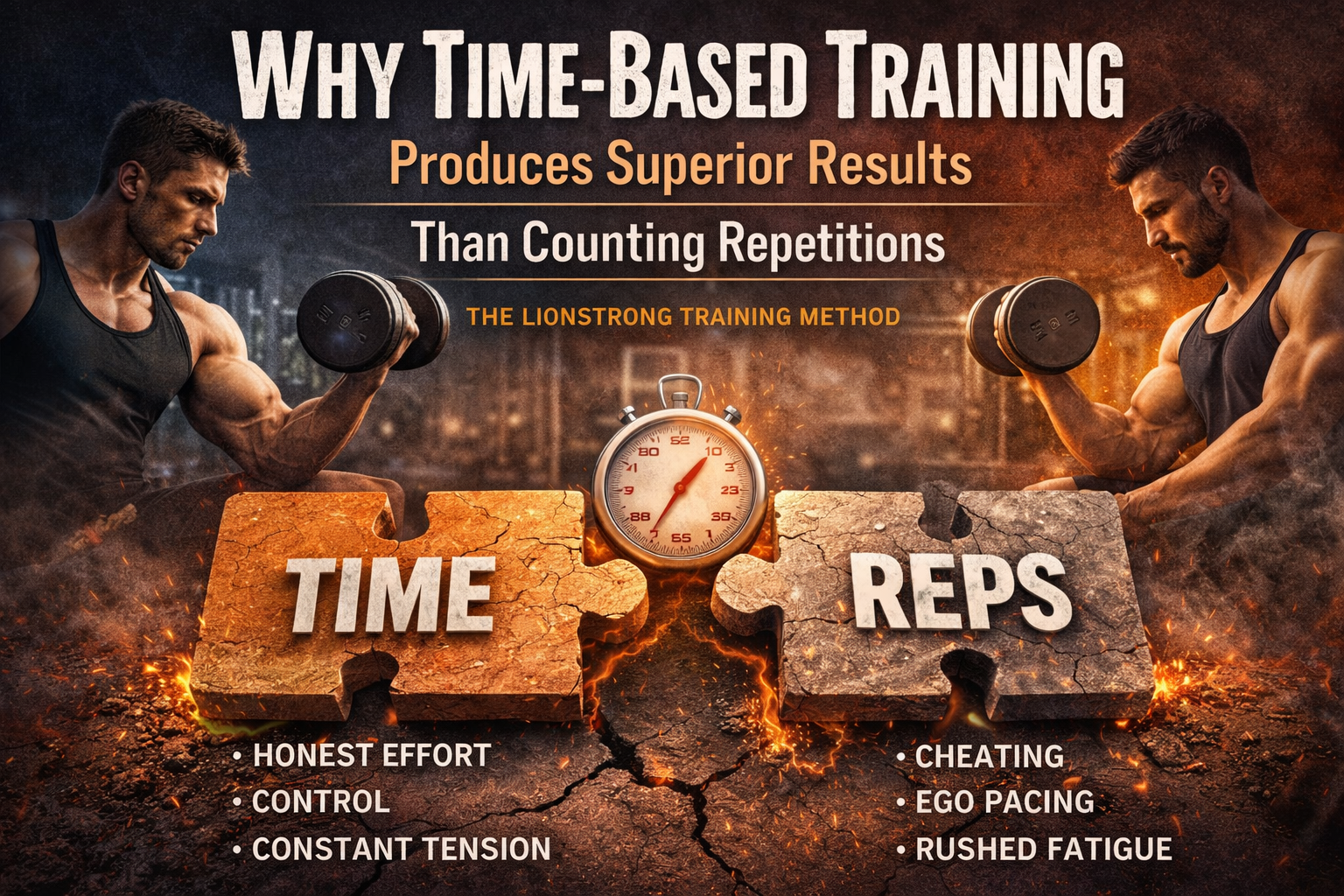
Why Time-Based Training Produces Superior Results Than Counting Repetitions
The Problem With How Most People Measure Training
For decades, fitness has been reduced to numbers:
How many reps?
How many sets?
How much weight?
These questions dominate training conversations — yet they miss the most important variable of all:
How long the body is actually under meaningful tension.
Two people can perform the same number of repetitions with the same weight and experience completely different outcomes.
Why?
Because repetitions do not measure effort.
They measure completion.
Time, on the other hand, exposes truth.
This is why Lionstrong training systems are built around time-based effort, not rep counting — and why this approach produces superior strength, muscle, and conditioning simultaneously.
The Fundamental Flaw of Rep Counting
Reps allow people to hide from effort.
They hide behind:
momentum
partial ranges of motion
strategic rest inside sets
ego-driven pacing
A person can “complete” 10 reps while only placing the muscle under meaningful tension for a fraction of the set.
From a physiological standpoint, this is inefficient.
Muscle adaptation is driven by:
mechanical tension
metabolic stress
muscle fiber fatigue
Reps do not guarantee any of these.
Time does.
Time Forces Honest Intensity
When you train for time:
the muscle must remain engaged
tension cannot be escaped
fatigue accumulates honestly
weaknesses are exposed immediately
There is no rushing through reps.
There is no coasting at the end of a set.
The clock doesn’t care how strong you think you are.
It only reflects:
control
endurance
resilience
output under fatigue
This is why time-based training standardizes effort across all levels — beginner to advanced.
Time Under Tension and Muscle Growth
Muscle does not grow because you completed a rep count.
It grows because it was forced to sustain tension long enough to require adaptation.
Time-based sets:
maximize motor unit recruitment
extend mechanical loading
increase metabolic stress
improve neuromuscular coordination
This results in high-quality hypertrophy, not just cosmetic muscle.
In Lionstrong training, muscle growth is a byproduct of sustained tension, not isolated rep targets.
Why Time-Based Training Builds Functional Strength
Functional strength is not about how much weight you can move once.
It’s about:
how well you control load
how long you can sustain output
how stable you remain under fatigue
Time-based training demands:
stabilizer engagement
joint control
coordination under stress
This creates strength that transfers to real life, not just gym environments.
That’s why Lionstrong prioritizes:
dumbbells
free movement
controlled tempo
continuous tension
Strength isn’t useful if it collapses when conditions aren’t perfect.
Cardiovascular Adaptation Without “Cardio”
One of the most overlooked benefits of time-based training is its impact on cardiovascular endurance.
When muscles remain under tension for extended periods:
heart rate stays elevated
oxygen demand increases
energy systems are challenged
recovery capacity improves
This creates cardiovascular adaptation without separating strength and conditioning.
That’s why Lionstrong training produces:
strength
hypertrophy
conditioning
All within the same session — under 30 minutes.
Why Time-Based Training Protects Joints
Joint pain often results from:
excessive loading
poor control
rushed repetitions
fatigue without structure
Time-based training emphasizes:
control over load
tension over momentum
technical failure over ego failure
This approach:
improves joint stability
strengthens connective tissue
reduces chaotic movement
builds long-term resilience
Smart stress heals joints.
Random stress breaks them down.
Time-Based Training and Recovery
Because effort is standardized by time, recovery becomes predictable.
This allows:
consistent training frequency
manageable fatigue
intelligent nutrition support
Lionstrong nutrition systems are designed to complement this exact style of training:
adequate protein
recovery support
inflammation management
sustainable caloric intake
Training and nutrition reinforce each other — not compete.
Why Time-Based Training Is Ideal for Real Life
Most people don’t fail because training is ineffective.
They fail because:
sessions are too long
plans are too complex
effort is inconsistent
life gets in the way
Time-based training solves this by:
limiting session duration
eliminating rep counting
simplifying execution
standardizing effort
When effort is honest and time is controlled, consistency becomes possible.
Systems Beat Methods
Rep schemes are a method.
Time-based effort is a system.
Systems adapt when conditions change.
That’s why Lionstrong training systems scale:
across skill levels
across environments
across lifestyles
They don’t rely on perfect conditions — only on execution.
Final Thought: Why Lionstrong Chooses Time
Reps are a counting method.
Time is a truth mechanism.
Lionstrong chooses truth — because truth produces results.