
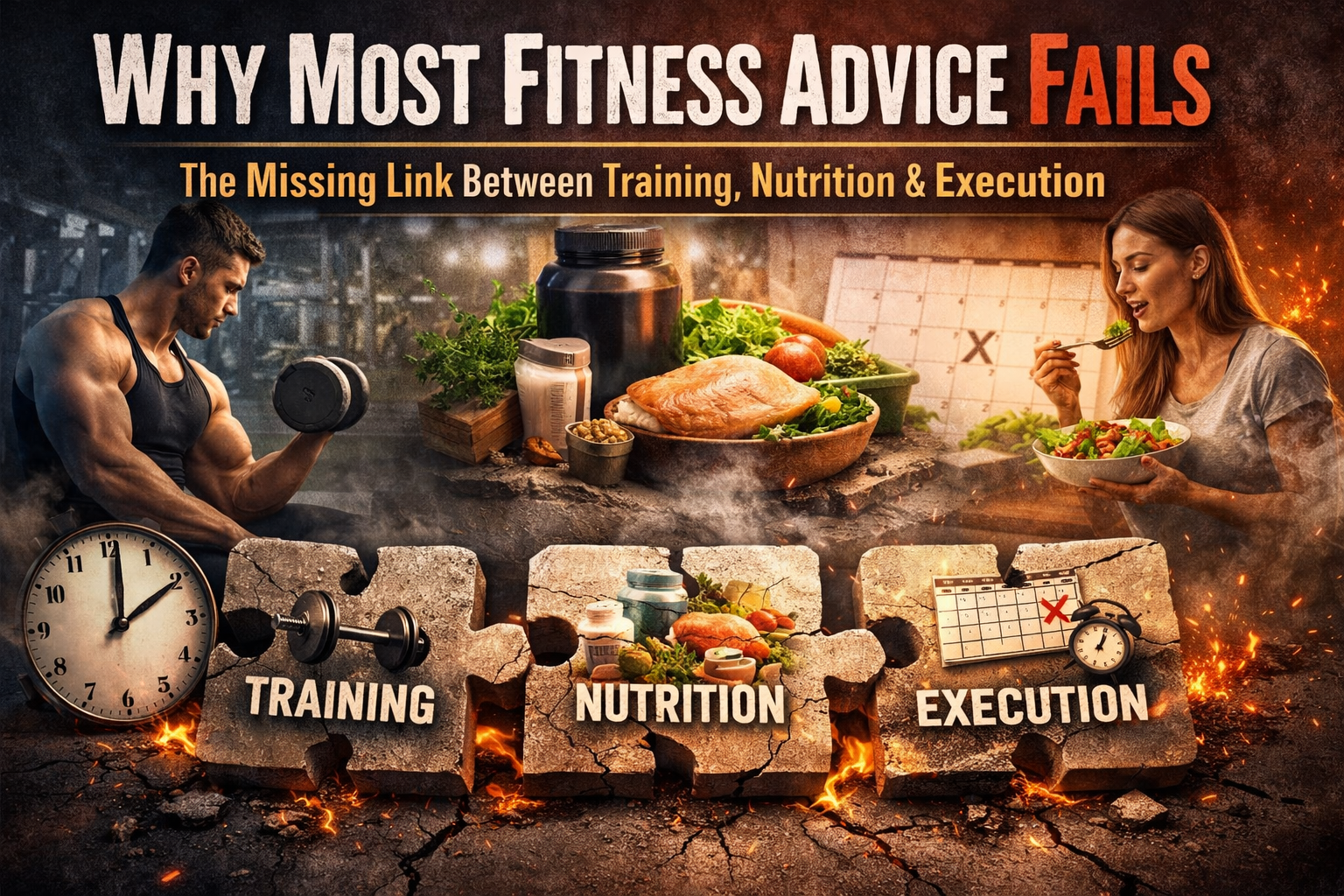
Why Most Fitness Advice Fails: The Missing Link Between Training, Nutrition, and Execution
The Fitness Industry’s Biggest Illusion
The fitness industry has never had more information available — and yet, it has never produced worse long-term results for the average person.
People know what to do:
exercise more
eat better
stay consistent
But knowing isn’t the problem.
The real problem is that most fitness advice is built around isolated ideas, not integrated systems.
Training is discussed as if nutrition doesn’t exist.
Nutrition is discussed as if training doesn’t matter.
Motivation is emphasized while execution is ignored.
The human body does not operate in fragments — it operates as a system.
And when fitness advice fails to reflect that reality, results fail to show up.
The Fragmentation Problem in Modern Fitness
Most fitness advice falls into one of three disconnected categories:
Training-only programs
Nutrition-only approaches
Motivation-first messaging
Each of these may sound compelling on its own, but none of them work reliably in isolation.
Training without nutritional support leads to:
poor recovery
stalled progress
joint issues
burnout
Nutrition without training leads to:
muscle loss
metabolic slowdown
rebound weight gain
fragile results
Motivation without structure leads to:
inconsistency
emotional decision-making
repeated restarts
frustration
This fragmentation is why so many people feel like they’re always trying but never truly progressing.
Why “Good” Advice Still Fails Most People
Even well-intentioned advice often fails because it ignores execution friction.
Execution friction includes:
limited time
limited equipment
inconsistent energy
real-life stress
decision fatigue
A plan that only works when life is perfect is not a plan — it’s a fantasy.
Most people don’t fail because they’re lazy or undisciplined.
They fail because the system they’re following was never designed for real life.
This is where most fitness brands get it wrong.
They optimize for:
impressiveness
novelty
complexity
Instead of:
accessibility
repeatability
sustainability
Training Is the Stimulus — Not the Result
Training does not create results on its own.
Training provides a stimulus — a signal that tells the body to adapt.
But adaptation only happens when that stimulus is:
consistent
recoverable
supported nutritionally
Without proper nutrition:
muscle protein synthesis is compromised
connective tissue recovery suffers
energy output declines
injury risk increases
This is why Lionstrong training systems are built around efficient, high-quality stimulus rather than excessive volume.
Key principles include:
time under tension instead of rep counting
constant tension to maintain muscular engagement
training for time to standardize effort
controlled failure to force adaptation without chaos
This approach allows meaningful progress without requiring hours in the gym.
Why Nutrition Without Training Backfires Long-Term
Nutrition alone can change scale weight — but it rarely improves body composition.
When calories are reduced without resistance training:
muscle tissue is lost
resting metabolism declines
insulin sensitivity worsens
fat regain becomes more likely
This is why so many people experience:
initial weight loss
followed by plateaus
followed by rebound gain
The body is simply adapting to survive, not to perform.
Lionstrong nutrition systems are not restrictive diets.
They are execution frameworks designed to support training adaptation.
They emphasize:
protein density
repeatable meal structures
cultural sustainability
global accessibility
long-term compliance
Nutrition exists to support training stress, not replace it.
Execution: The Most Ignored Variable in Fitness
Most fitness programs fail not because of poor science — but because of poor execution design.
Execution fails when:
decisions are too frequent
rules are too rigid
expectations are unrealistic
systems are too complex
Lionstrong systems are intentionally designed to reduce decision-making.
That’s why:
workouts are under 30 minutes
equipment is dumbbell-based
nutrition is framework-driven
effort is standardized through time
When execution becomes simple, consistency becomes automatic.
Systems vs. Routines: The Lionstrong Difference
A routine tells you what to do.
A system tells you how to adapt when conditions change.
Lionstrong systems are built around:
accessibility (dumbbells, minimal setup)
scalability (beginner to advanced)
repeatability (no constant novelty chasing)
integration (training + nutrition working together)
This is what allows results to compound instead of reset.
Why Integration Is the Only Sustainable Path Forward
True transformation occurs when:
training creates the stimulus
nutrition supports adaptation
execution remains frictionless
When these elements work together, progress becomes predictable.
Not extreme.
Not dramatic.
But reliable.
This is why Lionstrong isn’t about quick fixes.
It’s about building:
durable strength
resilient joints
functional muscle
sustainable health
Final Thought: Why Lionstrong Works When Others Fail
Most people don’t need more information.
They need a system that:
respects their time
adapts to real life
removes guesswork
compounds results
That’s what Lionstrong provides.
Not motivation.
Not hype.
A system.