
Why Most Fitness Advice Fails — And What Actually Works Long-Term
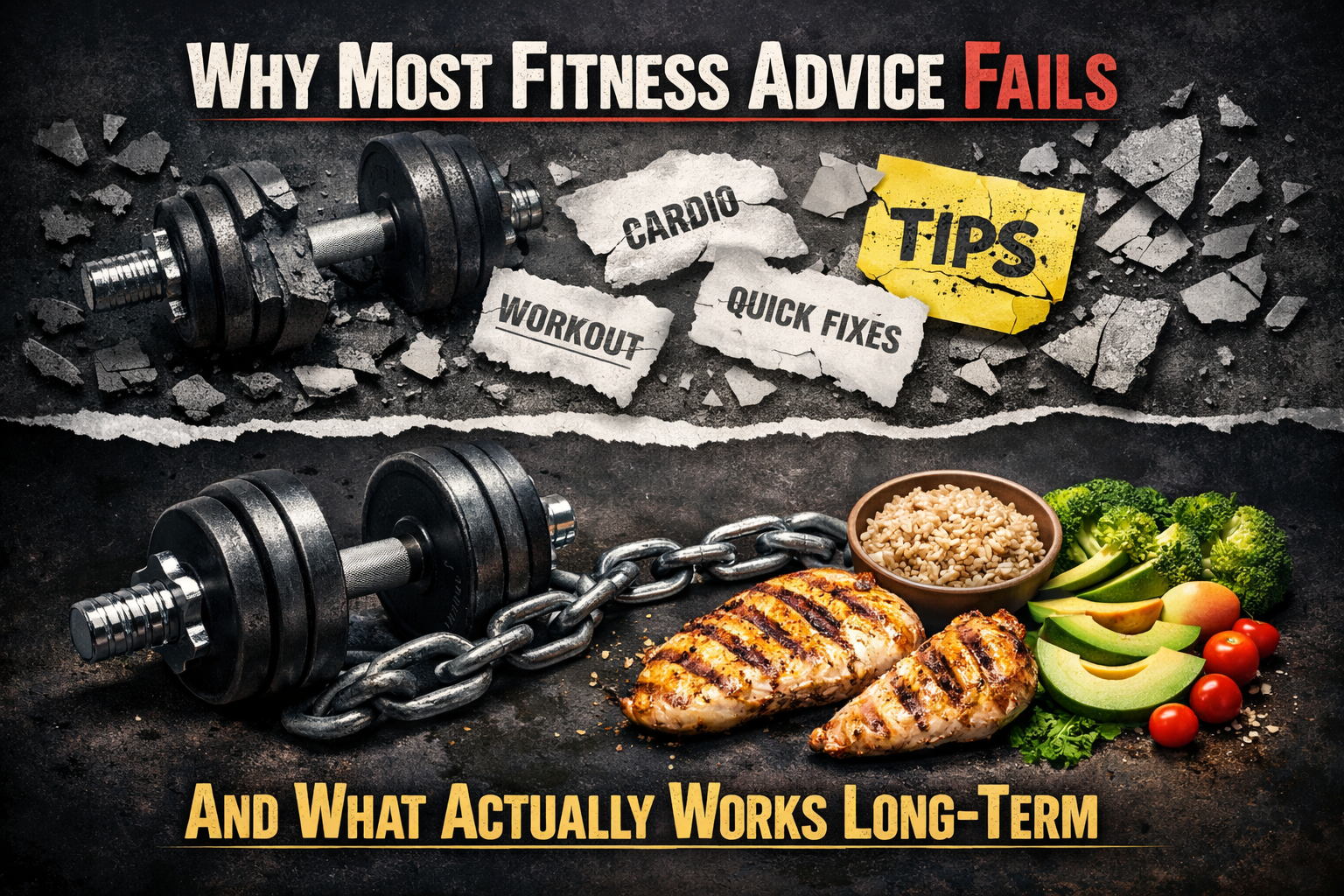
The Problem No One Wants to Admit
The fitness industry is loud, crowded, and overwhelmingly confusing.
Every day, people are bombarded with conflicting advice:
“Lift heavier.”
“Lift lighter.”
“Train longer.”
“Train less.”
“Cut carbs.”
“Eat more carbs.”
“Just be in a calorie deficit.”
“Do more cardio.”
“Avoid cardio.”
And yet, despite all this information, most people still don’t get results — or worse, they get results briefly and then lose them.
This isn’t because people are lazy.
It isn’t because they lack motivation.
And it certainly isn’t because they aren’t trying hard enough.
It’s because most fitness advice is fragmented, context-less, and unsustainable.
Fitness has been reduced to isolated tactics instead of systems.
And systems are what actually work.
Why Random Workouts Create Random Results
One of the biggest mistakes people make is confusing activity with progress.
They:
Jump from workout to workout
Chase novelty instead of mastery
Change programs every few weeks
Follow whatever trend is popular that month
This creates constant stress on the body without adaptation.
Your body does not change because you did something “hard.”
Your body changes because it adapts to intelligently applied stress over time.
Without structure:
There is no progression
No predictability
No sustainability
Random workouts don’t fail because they’re intense — they fail because they lack continuity.
Why More Is Not Better (And Often Makes Things Worse)
The mainstream fitness culture glorifies:
Long workouts
Excessive volume
Daily exhaustion
“No pain, no gain” mentality
But here’s the truth most people don’t want to hear:
More work does not equal better results. Better work does.
Long workouts:
Increase joint wear and tear
Elevate stress hormones chronically
Reduce recovery capacity
Decrease long-term consistency
The goal of training is not to survive the workout.
The goal is to:
Stimulate muscle
Improve conditioning
Enhance performance
Recover fully
Repeat consistently
That requires precision, not punishment.
Why High-Quality Muscle Is the Real Fat-Loss Engine
Fat loss is not a cardio problem.
It is not a starvation problem.
It is not a willpower problem.
It is a metabolic problem.
Muscle is metabolically active tissue.
The more functional muscle you have:
The more calories you burn at rest
The more food you can tolerate
The better your insulin sensitivity
The healthier your joints become
This is why people who focus only on eating less eventually stall.
They shrink their metabolism instead of building one.
Training should create the calorie deficit, not extreme restriction.
Why Time-Under-Tension Beats Ego Lifting
One of the most overlooked principles in training is time under tension.
Momentum-based lifting:
Reduces muscle engagement
Increases joint stress
Relies on leverage instead of control
Controlled, tension-based training:
Maximizes muscle recruitment
Improves mind-muscle connection
Enhances joint safety
Builds real strength, not just numbers
This is why dumbbells — when used properly — are so powerful.
They don’t allow compensation.
They don’t hide weaknesses.
They force the body to work honestly.
Why Training Should Dictate Nutrition (Not the Other Way Around)
Most people eat based on fear:
Fear of carbs
Fear of calories
Fear of gaining weight
Athletes eat based on performance demands.
Food is not the enemy.
Food is fuel.
When training is structured properly:
Nutrition becomes supportive instead of restrictive
Fat loss becomes a byproduct, not a struggle
Energy levels improve instead of decline
You don’t eat less to get lean —
You train better so your body can handle more.
Why Systems Win Where Motivation Fails
Motivation is unreliable.
Discipline without structure burns people out.
Systems remove emotion from the equation.
A proper system:
Tells you exactly what to do
Eliminates guesswork
Scales with your life
Works whether motivation is high or low
This is the difference between people who stay fit for decades
and people who restart every January.
The Lionstrong Philosophy
At Lionstrong Fitness Global, the approach is simple:
Train with intent
Build muscle intelligently
Protect joints
Fuel performance
Repeat consistently
This is not about trends.
This is not about gimmicks.
This is about creating a body that works for you, not against you.
Ready to Stop Guessing?
If you’re tired of:
Conflicting advice
Starting over repeatedly
Beating up your joints
Working hard without lasting results
Then it’s time to follow a system, not just advice.
These systems are designed to:
Work anywhere
Require only dumbbells
Scale with real life
Deliver results you can maintain